Can you still make money from a failed startup?
TL;DR
- When a startup shuts down, AI labs and the companies that supply them will now pay for its Slack, emails and code. SimpleClosure, which brokers many of these sales, says its deals in the year to April 2026 paid between $10,000 and $100,000.
- They use it to build practice offices for AI agents, because the public internet shows almost nothing of how work happens inside a company.
- The money usually goes to creditors and investors, not to the employees who wrote the messages. Coding-agent transcripts could be the next archive, and AI chat transcripts have already been sold without their owners knowing.
I know how it feels when something you built stops working. For me it was options trading first, then my own trading community, where I shared what I knew. It took several years to get it on solid ground, and for a while I made money from both. Then trading stopped fulfilling me, and the earnings turned into losses.
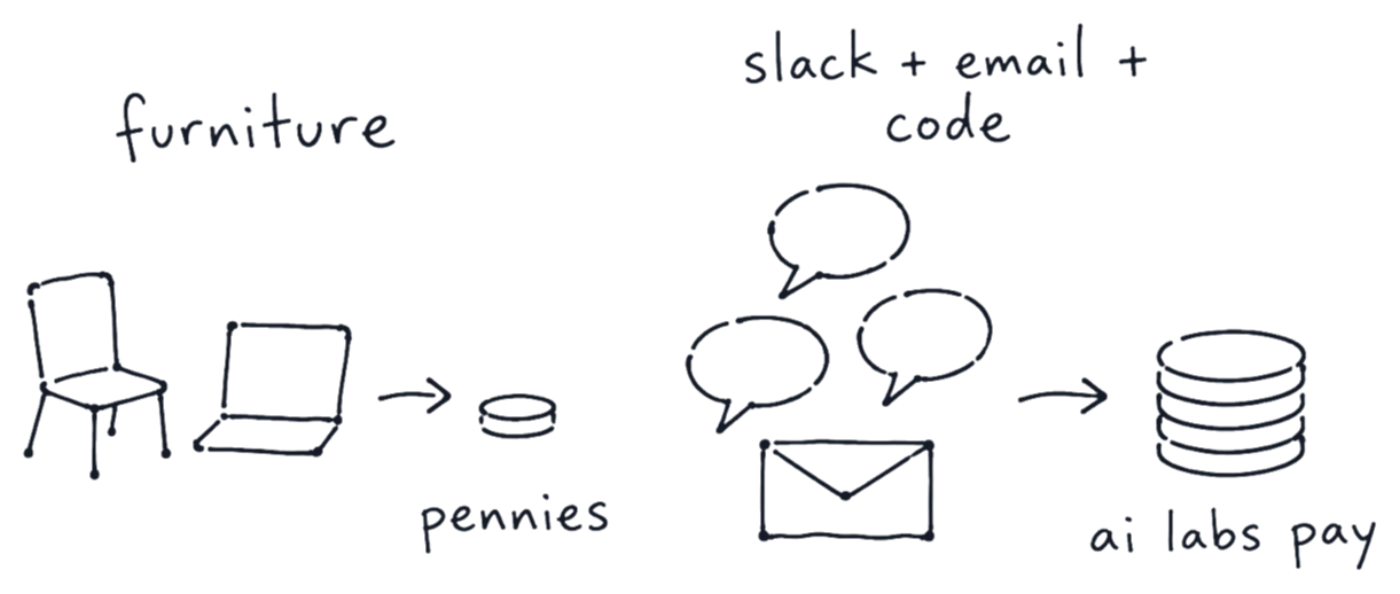
A lot of founders go through some version of this, and the end usually looks the same: you sell the chairs, desks and laptops for a fraction of what they cost and write off the rest. Since 2025 there’s one more thing buyers want. So to answer the title: yes. If your company is dead but you still have its conversations and its code, AI labs and their suppliers will pay for them. Whether yours sells, and for how much, is a different question.
What’s for sale
There are two kinds of archive. The first is the human one: Slack, email, calendars, documents, tickets. Years of people solving problems in writing. This is the one with documented sales. In April 2026 SimpleClosure, a US company that helps founders wind down their startups, launched Asset Hub, where its clients can sell their code and, at first in beta, their workspace data. By October, MIT Technology Review was calling the businesses that serve dying startups “a new growth sector in tech”, and selling their data is one of the newer things those businesses do.
The second is the archive from coding agents like Claude Code or Cursor: every session where you and the agent built the product together. I’ll come back to it at the end, because that part is my own theory. I haven’t found a single documented case of a founder selling one.
How much it pays
The biggest known deal isn’t a startup at all. Spirit Airlines stopped flying in May 2026, and in August Google won the bankruptcy auction for its internal data with a $10 million bid, ahead of the AI data company Mercor at $7.5 million. The package put up for auction listed around 100 million emails, 500 million Microsoft Teams messages, about 30 million lines of code, payroll records from 2016 and employee records going back to 1986. Passenger databases are left out. Google says the data can help it improve its products and AI models.
It isn’t done, though. Spirit’s flight attendants’ union objected on privacy grounds, and in October more than 100 members of Congress asked Google and Spirit to leave out employee information as far as possible. The court hearing has been pushed back five times. As of 3 November 2026 the judge hasn’t ruled, and the next hearing is set for 6 November.
Small companies get far less. SimpleClosure told Forbes in April that nearly 100 deals in the past year had paid between $10,000 and $100,000 per company. MIT Technology Review talked to Keelan Miskell, who ran a crypto startup for two and a half years. He got about $25,000 for the code and was still waiting on another payment, likely around $15,000, for the work data in Google, Notion, Figma and Slack. “At least all that stuff we were doing for two and a half years is worth something to someone somewhere,” he said.
At the top end is cielo24, a transcription and captioning company. When its CEO Shanna Johnson shut it down, SimpleClosure sold 13 years of its Slack messages, Jira tickets and emails for “hundreds of thousands of dollars”. She went from not knowing how to pay the bills to closing the company cleanly.
There’s some irony in that. Closing a company properly costs money, and now the company’s own archive can pay for its funeral. SimpleClosure’s CEO Dori Yona started the company after he was told to shut down his previous startup, Earny, and had to plan the whole thing himself (in the end Earny was sold instead). By SimpleClosure’s count, Asset Hub has handled more than 150 deals, and according to Yona, 47% of all its deals now include code or data. Those are the company’s own numbers, not an audit.
Why AI labs want your old chats
AI labs are trying to build agents: models that do an employee’s work, like answering a ticket, sorting out a calendar or fixing a bug. The public internet taught models a lot, but it shows very little of what happens inside a company: who asked whom, what went wrong, how the argument got settled. Your Slack has exactly that.
Do you remember the sport you did as a kid? For me it was boxing. Hours in the gym, and every day I had to simulate a fight, picturing the other guy and how I’d react to what he did. It was only a simulation, but it was the most important part of the preparation. AI agents have their own version, the RL gym (RL stands for reinforcement learning). It’s a simulated company with tickets, emails and disputes, where the agent gets a task, does the work and gets rewarded when it solves it well. Some of those gyms are built from real company data, and that’s what the buyers want it for.
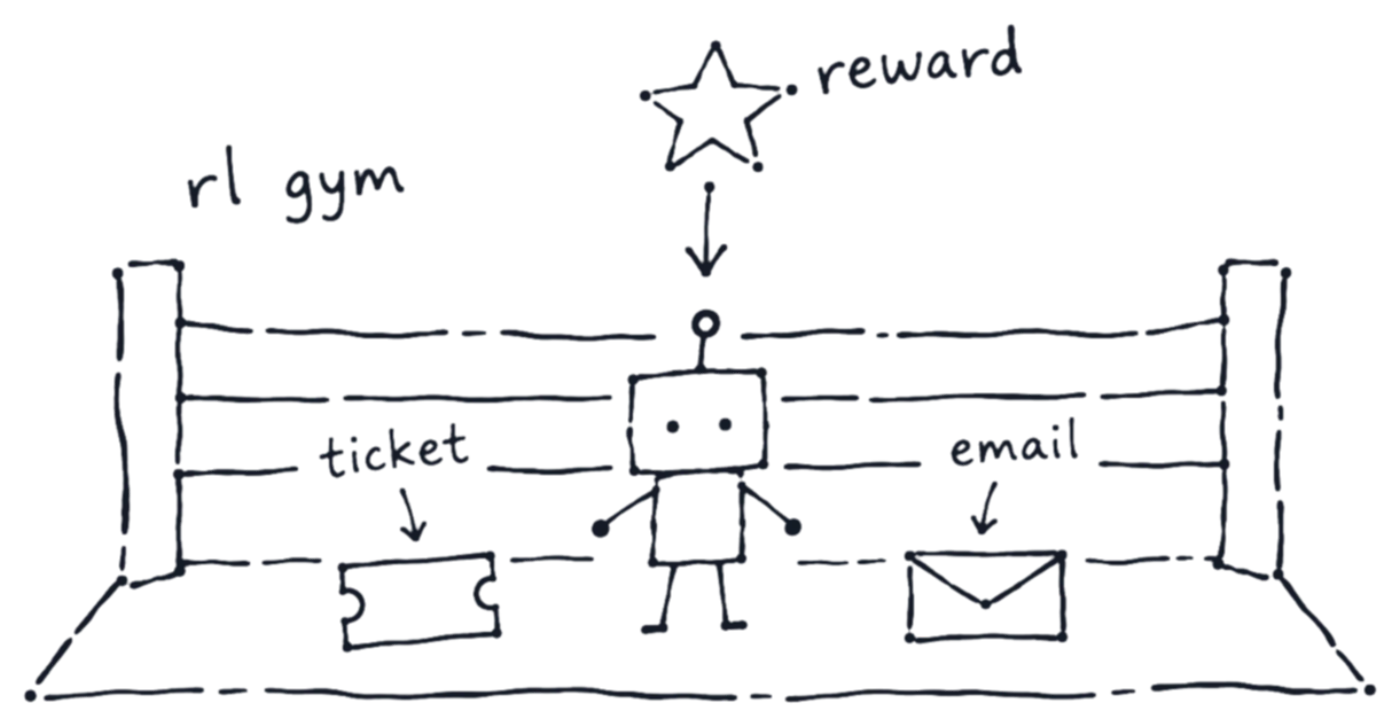
Buyers want the messy parts. Nick Heiner of Surge AI, which buys data for these gyms, told MIT Technology Review he looks for archives with everything from disagreements to tricky judgment calls. One company’s Slack with that kind of variety and depth, he said, can be worth more than another company’s Slack, email and calendars combined. Ali Ansari of micro1, which sells labs a mock holding company for agents to practice in, told Forbes that “the noise in the real-world environments is required to accurately test models.”
Why not let AI make the data up? According to MIT Technology Review, synthetic data has mistakes a real archive doesn’t, like references to dates that don’t exist. To be fair, the same article said in October that no company had yet published a test comparing training on real data with the alternatives. So buyers are paying for a belief, not a proven effect. The logic behind it is clear enough, though.
Who gets the money
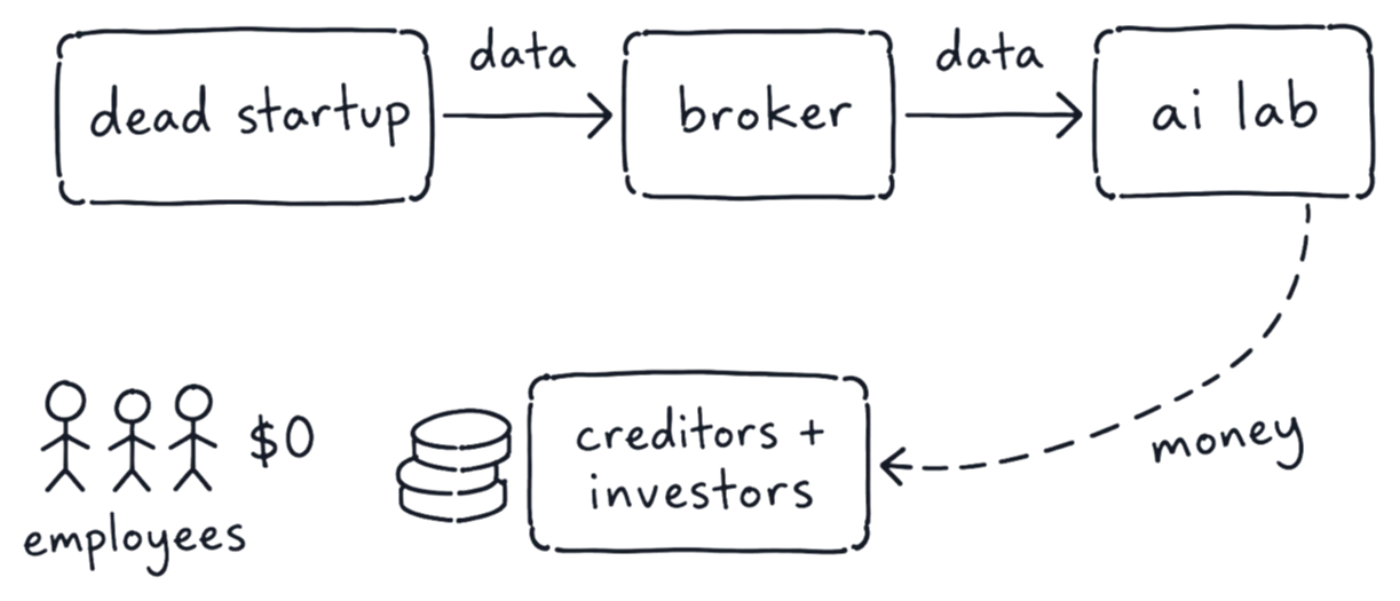
A deal goes roughly like this. The company dies, and the founder has to pay the employees, settle the debts and cancel the contracts. A broker like SimpleClosure prepares the archive and, by its own account, removes the personal data. Then it goes to a buyer: a lab, one of the vendors that build gyms for labs, or a big tech company training its own models. The proceeds, MIT Technology Review writes, “typically flow to senior creditors and investors—not employees”.
So the employees who wrote the messages usually see none of it, and as law professor Ifeoma Ajunwa points out, no US federal law bans these sales. The scrubbing is the weak spot. There’s no “remove identity” button, and taking the names out doesn’t make an archive anonymous. Spirit’s flight attendants’ union argued that the links between emails, schedules and records stay in the data, so people could be pieced back together even without their names. Greg Ewing, an attorney who advises AI startups, has called this kind of data “legally radioactive”, and emails and calendars are full of doctor appointments, school pickups and date-night plans.
If you’re winding a company down, find out what the archive is worth before you delete it, and think about asking your old team before you sell what they wrote. That’s not advice though.
Coding-agent transcripts
Now back to my theory. When you build with a coding agent, the saved session (the transcript) holds more than the final code: the task, what the agent tried, where you corrected it, how the problem actually got solved. Jacek Migdal of Quesma collected how much AI companies already want this. Cursor says its approach to code search “uses agent sessions as training data”. Meta’s Contributor tier charges 12.5 times less per input token on its Muse Spark model if you let Meta train on what you send and what it answers. Anthropic analyzed 200,000 Claude Code transcripts from its own staff, and its guide to testing agents tells readers in its conclusion: “Read the transcripts!”
The same piece points to Anthropic’s threat report from September 2026: Chinese labs bought transcripts of people’s conversations with US AI models from resellers, including proxy operators who had saved them without the users knowing. Those were ordinary chats, and the report doesn’t say any of them were coding sessions. Still, AI transcripts already sell, just not legally. A legal market where a founder sells their own agent history, I haven’t found yet. I think it will show up.
If you build with agents, keep the transcripts. Claude Code on the command line keeps them for 30 days by default and then cleans them up, so the archive only exists if you save it somewhere. And clean them before anyone else sees them: agents can read .env files and API keys, and whatever they read is saved in the transcript in plain text.
Thanks for reading,