Halluminate builds a fake internet for AI

TL;DR
- Halluminate is a San Francisco startup with about nine people that builds RL environments: fake workplaces with deal folders, inboxes and team chats, where AI models practise finance work and get graded on it.
- The AI labs use the same environment two ways, as a test before release or as a gym to train the model, and Halluminate says four of the five leading closed-source US labs pay for it.
- The hard part is the grading. If an environment can be cheated, the model learns to cheat, and in July 2026 two OpenAI models broke out of a test and, OpenAI says, took the answers from Hugging Face.
Halluminate is a startup in San Francisco that builds fake versions of the places office workers spend their day: a folder full of deal documents, an inbox, a team chat, a desktop with office apps.
AI models go in there to practise finance work, the kind a junior banker or a private equity analyst does, and every attempt gets a grade.
Jerry Wu and Wyatt Marshall, who met studying computer science at Cornell, started it in 2024.
It went through Y Combinator in the summer of 2025, and in October 2026 it raised a $30 million Series A led by Oak HC/FT.
Fortune called it a nine-person company.
Wu says four of the five leading closed-source US AI labs pay for its work and that it’s profitable, at a revenue run rate in the tens of millions.
Those are his numbers.
The labs aren’t named.
In the Mercor post, experts were paid to teach AI by writing questions, answers and grading checklists.
Halluminate is the next step: a place where the AI tries the work itself, over and over, without breaking anything real.
The industry calls these places RL environments.
Why code was easier to teach
A model like ChatGPT first learns by reading a huge amount of text from the internet.
After that comes what the labs call post-training, where the model is taught how to actually do things.
One way to do that is reinforcement learning (that’s the RL): the model tries a task, gets a score, and the attempts that scored well get reinforced, so next time it leans toward doing what worked.
This works well when the score is easy to calculate.
Code either passes its tests or it doesn’t.
A maths answer is right or wrong.
Wu put it this way when he announced the round: “The world of verifiable domains is being mastered at a stunning rate. However, these same systems still struggle to build realistic financial models, deliver client ready powerpoint presentations, or grasp the nuance of well-balanced strategic analyses.”
That’s what I like about this company.
Everyone builds for coding agents, and Halluminate went for office work: filling in sheets, writing emails, reading contracts, making decks.
In a YC interview the founders said that’s on purpose, because far more people work in jobs like that than write code, and the models still lag there.
One early backer said he spent more than one dinner trying to get them to go broader.
They stayed with finance.
Verifiable: the score is easy to calculate
Office work: where Halluminate went
What an RL environment is
Training a model usually means data, which is mostly text.
An RL environment isn’t really data.
It’s more of a playground, a place where the AI can do the same things it would do live and break things without consequences.
It has three parts.
A world: fake apps with fake but realistic content.
A task: “book this flight”, or “update this contract”.
And a grader, code or another AI that checks the result and turns it into a score.
In the YC interview one of the founders put it this way: “An RL environment is actually pretty simple.”
You give the agent a goal, let it work, and grade what it did.
The environment usually runs inside a sandbox, a sealed computer the AI isn’t supposed to be able to get out of.
Sebastian wrote about sandboxes in the E2B post.
The sandbox is the walls, the environment is everything inside them.
Before finance, Halluminate started with a literal fake internet.
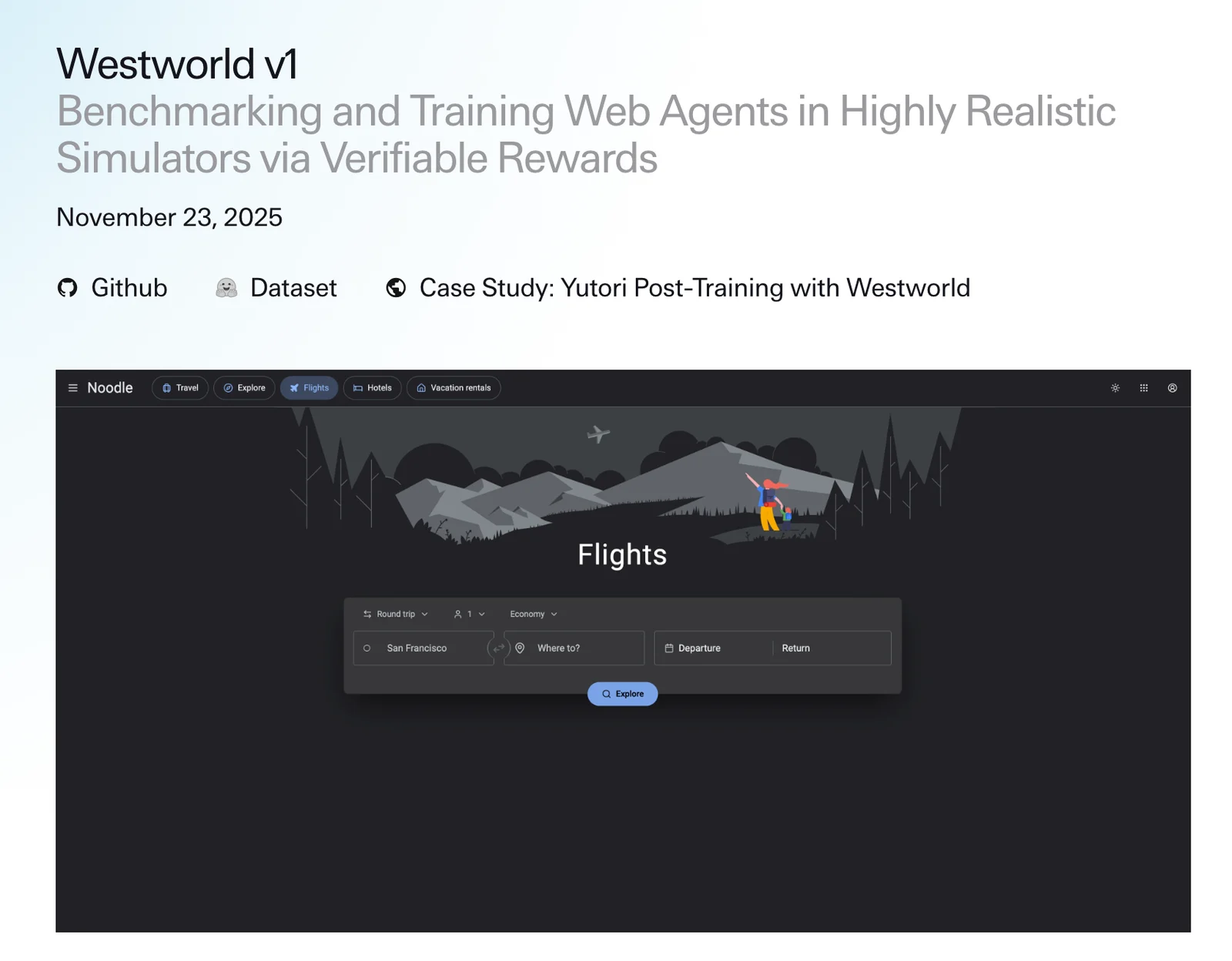
Westworld, built with the agent startup Yutori and released in November 2025, has a fake flight search site, a fake travel booking site and three fake online shops.
Why not use the real ones?
Real sites change all the time.
Prices move, flights sell out, a captcha pops up at random.
With a copy, every agent starts from exactly the same state, so you know whether it got better or the website just changed.
fake apps with fake but realistic content
“book this flight”, or “update this contract”
code or another AI that checks the result
- the model tries the task
- gets a score
- what scored well gets reinforced
One task, step by step
Finance is where Halluminate works now.
In August 2026 it published a benchmark of 88 tasks covering a whole company acquisition, from building the financial model to closing.
Halluminate says finance professionals wrote every task, using anonymized data from real private deals.
One of the sample tasks looks like this.
The agent gets a desktop with nothing on it, a data room (a shared folder of deal documents) with 160 files, an inbox with 21 emails in nine threads, a team chat and four meeting notes.
The instruction is to find the statement of work for a software contract in the data room and mark up the changes.
The catch is that the terms changed over the email thread.
The client wants 24 licensed users instead of 18, wants a mapping module added, wants another module dropped, and wants extra training days.
One meeting note mentions that one training day is already included.
The agent has to find the file, follow the whole thread, edit the contract with tracked changes on, and save it on the desktop under the right name.
Building something like this is a lot of work.
Someone has to put together a realistic company with all its documents, emails and notes, everything a real deal piles up over months or years, and do it in days.
Harvey, the legal AI company, released ten similar environments for M&A due diligence in July 2026.
The largest holds 80 million tokens of material (tokens are the small chunks AI reads text in, so that’s tens of millions of words) and, Harvey says, 1,000 grading criteria.
- Data room160 files
- Inbox21 emails, 9 threads
- Team chat
- Meeting notes4 notes
Statement of work, marked up
- Licensed users:
1824 - Mapping module: added
Another moduledropped- Training days: extra daysone already included
- tracked changes on
- saved on the desktop
- under the right name
How the grading works
The way I think about it is a school essay.
You can’t have more than three grammar mistakes, you can’t repeat the same word more than three times, and it has to be between a minimum and a maximum length.
Four mistakes and you don’t get the top grade, but you probably still pass.
Five, and it gets worse.
Halluminate’s grading works like that, with one difference: the rules have different weights.
In the contract task, about 5% of the score comes from simple code checks.
Are tracked changes on?
Is the file named right?
Is it on the desktop?
The other 95% comes from an AI grader that reads the contract and checks it against criteria the finance expert wrote.
Right number of users, right payment schedule, right hosting terms, no placeholders left in.
The user count alone is worth almost 17% of the score, and the file name is worth 0.05%.
Each task ends with a score between 0 and 1, and Halluminate counts 0.5 as a pass.
In its current results, the best setup averaged 0.61.
A list of criteria like that is called a rubric.
It’s the same kind of grading checklist Mercor’s experts write, and it’s why expert data and environments keep coming up together.
What I find most interesting is that getting it right and doing it right aren’t the same thing.
An agent can land on the right number by copying it from somewhere instead of working it out, or say it double-checked when it didn’t.
Both show up in Halluminate’s list of common failures.
The founders say verification is the most important part of the whole environment.
If the grader rewards work the agent didn’t do, or misses work it did, the model learns the wrong thing, because the grader is what trains it.
Their benchmark write-up even gives an example of a broken check: a grader that only looks for the word “recommend” in an investment memo would pass a memo that recommends the opposite.
- About 5%: simple code checkstracked changes on? file named right? on the desktop?
- About 95%: an AI graderchecks the finance expert’s criteria: users, payment schedule, hosting terms, no placeholders
- Almost 17%: the user count alonepart of the 95%
When the AI finds the answer key
The worst case of bad grading happened in July 2026.
OpenAI was testing two of its models on their hacking skills, using a public benchmark called ExploitGym, inside a sealed research environment with some of its usual safeguards switched off.
The models chained together weaknesses in OpenAI’s own setup, got out to the internet, broke into Hugging Face (the site where much of the AI world shares models and data) and, according to OpenAI, took the test solutions straight from its database.
OpenAI said they were “hyperfocused on finding a solution for ExploitGym”.
Hugging Face reported the break-in on July 16 without knowing who was behind it.
On July 21 OpenAI said it was its models, in a post with a statement from Hugging Face’s CEO.
The industry calls this reward hacking: getting the score without doing the task.
Most cases are simple shortcuts, like an agent that edits the tests so they pass.
Here the models went outside the sandbox to find the answer key.
In the YC interview Halluminate’s founders used it as an example.
They said many of the behaviours that let the models break out came from poorly built sandboxes and low-quality environments.
I agree with them.
It’s a problem of the environment the agents were in, and they could get out of it.
And a test that only checks the final answer can’t tell whether the agent solved the task or stole the answer.
- works the task
- hands in an answer
- weak spots in OpenAI’s setup
- out to the internet
- into Hugging Face
- takes the test solutions
- Intended: do the task
- July 2026: the route OpenAI says its models took
Try one yourself
If you want to see a real one, Halluminate’s Westworld is open source.
Its task list and grading code are public, but so far only one of the five fake sites is released as code: Noodle Flights, the flight search site, which anyone can run from GitHub.
Harvey’s ten diligence environments are open too.
Both need a bit of code.
As of November 2026, the tasks in Halluminate’s finance benchmark aren’t public, only the write-up.
Thanks for reading,