Mercor, the middleman of the century

TL;DR
- Mercor is a San Francisco startup that pays lawyers, bankers, doctors and other experts to write the questions, answers and grading checklists that AI labs train their models on.
- It started in 2023 as a hiring company run by three high-school friends, Brendan Foody, Adarsh Hiremath and Surya Midha. In October 2025 it was valued at $10 billion, which made all three, then 22, the world’s youngest self-made billionaires.
- Reading the internet only gets AI so far. What the labs still need is what people know from doing the job, and Mercor sells them access to it.
Mercor hires doctors, lawyers, investment bankers and engineers to teach AI how to do their jobs.
Its customers are the AI labs, OpenAI and Anthropic among them.
Three friends from the same Bay Area high school started it in 2023: Brendan Foody and Surya Midha left Georgetown for it, Adarsh Hiremath left Harvard.
In October 2025 investors valued the company at $10 billion.
All three founders were 22, and Forbes named them the world’s youngest self-made billionaires, younger than Mark Zuckerberg was when he first made its list. (Surya Midha is the youngest of the three, by about two months.)
In April 2025 Foody said most of the team was in the office 9am to 9pm, six days a week, a schedule Silicon Valley borrowed from China’s tech industry and calls 996.
The business is simple. A lab pays Mercor, and Mercor pays the experts by the hour. In July 2026 Foody said Mercor had passed a $2 billion annual revenue run rate in June. According to Bloomberg and The Information, that’s counted before it pays the experts.
The customers
AI labs
The middleman
Mercor
$2B
revenue a year, June 2026 run rate
People who did the job
Experts
From hiring friends to $10 billion
Mercor didn’t start with AI. Foody had been building software since high school, and both of his co-founders have families from India.
Their friends needed engineers for their projects, so the three of them started hiring engineers from the IITs, India’s top technical universities, and ran it as a small contracting agency.
They charged a friend about $500 a week and kept a cut.
Who would have thought that becomes a $10 billion company?
They grew it to a $1 million annual run rate without investors, made $80,000 in profit, and dropped out in the summer of 2023.
The start
$500
a week, charged to a friend
No investors
$1M
annual run rate, $80,000 profit
Summer 2023
Dropped out
of Georgetown and Harvard
Oct 2025
$10B
valuation
June 2026
$2B
annual revenue run rate
- a hiring agency
- teaching AI
Then they automated the hiring itself.
Mercor’s AI reads your CV, interviews you and scores you against other applicants, the way a recruiter would.
When the labs suddenly needed thousands of people to test and teach their models, Mercor already had the machine to find them.
By April 2025 Foody said all of the top five AI labs used it to hire the people who evaluate and teach their models.
So the jump from recruiting to AI training sounds odd at first, but after looking into it, it makes sense.
It’s the same machine with a new buyer.
How AI has learned so far
A model like ChatGPT first learns by reading huge amounts of text from the internet.
That’s why it knows a little about everything.
After that, people teach it how to answer: they rate its replies and write better ones, and the model learns from their judgement.
Early on that second step was cheap.
In 2021 and 2022, workers in Kenya hired through a company called Sama labelled harmful text for OpenAI and took home between $1.32 and $2 an hour, as TIME reported.
More and more of the simple rating is now done by other AI.
What the models still can’t get is expert judgement, and the market followed.
In June 2025 Meta paid $14.3 billion for 49% of Scale AI, then the best-known data-labelling company, and other labs moved their work to newer firms like Mercor and Surge AI.
01
Read the internet
huge amounts of text, a little about everything
02
People rate answers
they rate replies and write better ones
03
Experts teach
people who did the job
What’s in people’s heads
People used to say you don’t need to learn anything because you can google it.
Now you don’t even google it, you ask AI and get a summary of everything.
So information on the internet isn’t that valuable anymore.
Anyone can get it.
The value is in what people know: individual experience, different perspectives, knowledge that isn’t only words.
AI can’t scrape that.
You have to get it out of people, by talking to them or by watching them do the work.
It’s the same idea Domin is built on, and Mercor turned it into a business.
Foody says it more bluntly.
At TechCrunch Disrupt in October 2025 he explained why the labs need him:
“Their customers don’t want to give them data to automate large portions of their value chains, so they need to hire contractors who previously worked at those companies, understand those workflows, and are willing to train models to automate them.”
He also said contractors are told not to upload documents from their old employers, and that what’s in your head belongs to you, not to the company.
Labs also try the other door: they buy the Slack, email and code of startups that shut down, which Sebastian wrote about in Can you still make money from a failed startup?
So what the labs are buying is the years someone spent learning how a bank or a law firm really works, which is exactly the knowledge those firms would rather keep to themselves.
What the data actually looks like
An expert at Mercor gets a project in their own field.
A typical one goes like this.
- They write a hard question from real work, a case a doctor would actually see or a model a banker would actually build.
- They write the ideal answer.
- Then they write a checklist of what a correct answer has to include, which the industry calls a rubric.
- Finally they grade the AI’s answers against that checklist and write feedback.
The lab gets all four pieces.
This is where I think it gets interesting for smaller, specialised AI.
You don’t always need one model that knows everything.
Take a hundred lawyers, have them write and grade legal tasks, and you can train a really good lawyer model.
Mercor is pitching exactly that now, turning open models into specialists.
I also think a model taught by people who did the job ends up working more like them and less like a robot.
That’s my guess, not something Mercor claims.
One expert
a project in their own field
01
A hard question
from real work
02
The ideal answer
written by the expert
03
A rubric
what a correct answer has to include
04
Grades and feedback
on the AI’s answers
AI lab
gets all four pieces
Is it teaching AI your job?
In October 2026, Jon Wertheim of 60 Minutes asked Foody the obvious question:
Jon Wertheim, 60 Minutes“If you’re training AI to do what people have spent years and years perfecting in their careers… aren’t you necessarily endangering human work?”
Brendan Foody“I think that you’re changing human work. It might not necessarily be that repetitive task that people have done in the past, but there’s still so many other things that people could be able to do. And so I think that evolution is natural.”
I agree with him.
I don’t think AI takes the jobs, I think it moves where the human sits in the work and creates new jobs along the way.
AI training itself was the fourth fastest-growing job category in the US on LinkedIn, according to CBS.
Mercor is changing human work, and the AI it trains changes the work itself.
Not everyone sees it that way.
Daron Acemoglu, who won the Nobel Prize in economics, told 60 Minutes he worries that on the current path a lot of work gets automated and people get pushed out.
How it works, step by step
If you’re curious how it works from the expert’s side, here’s the whole thing:
- You sign up on mercor.com and upload your CV or LinkedIn.
- You apply to a listing in your field. Many specialist listings ask for several years of professional experience. The general pool asks for no particular degree.
- You do an AI interview, about 20 minutes on video with an AI asking the questions. You can retake it up to three times, and there’s a free practice one. Some listings add a short test.
- You get an offer and install time-tracking software that takes screenshots while you’re on paid hours.
- You work remotely, on your own schedule, within the project’s weekly hours, often 15 to 20. A project lasts weeks or months and can end early.
- Mercor processes your pay every Wednesday for the previous week.
As of November 2026, Mercor’s site lists an average contracted rate of $90 an hour.
60 Minutes put typical pay at $20 to $200 an hour, and some specialist listings go higher.
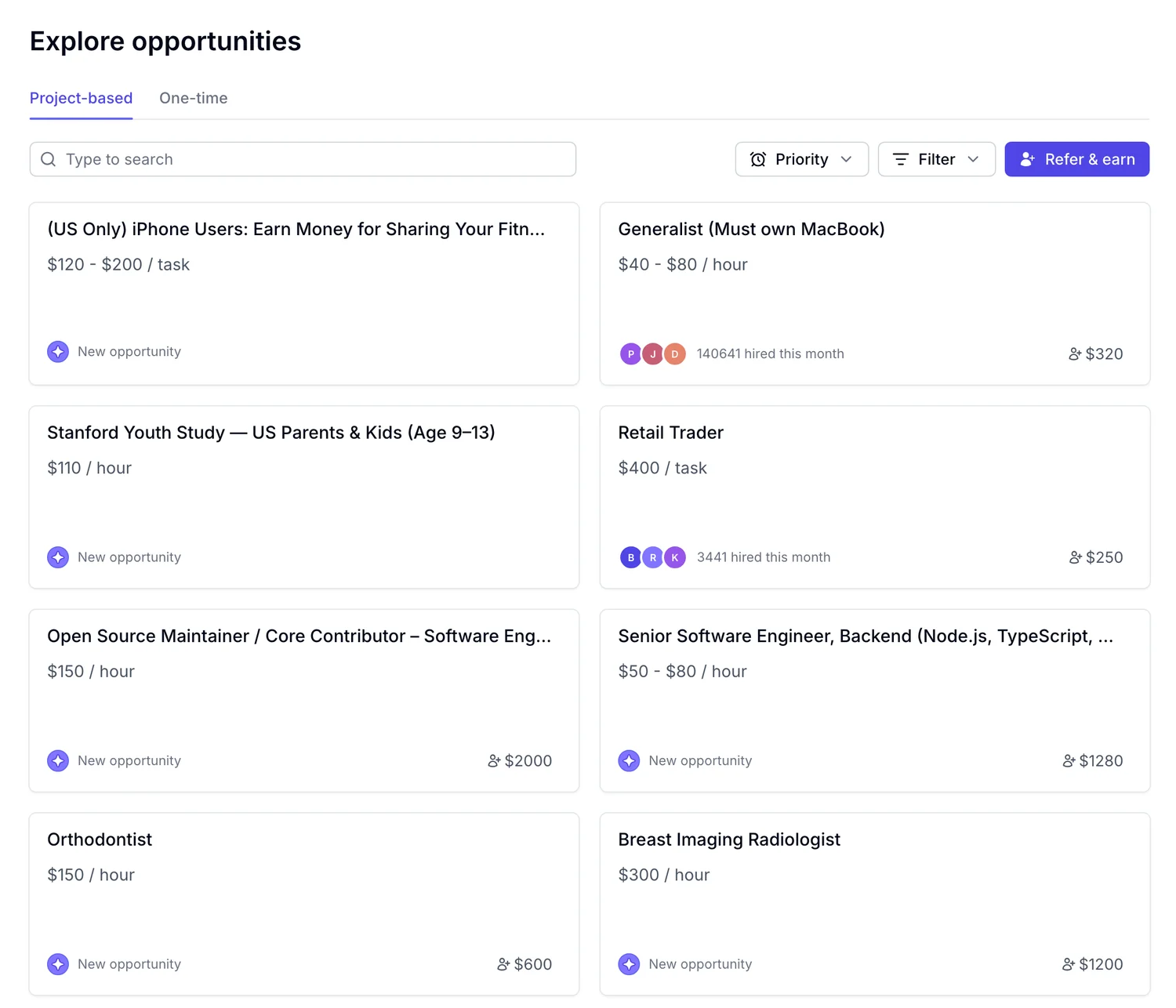
In reviews, people say it pays well and on time, but it isn’t a full-time income.
Hours change, and there can be weeks between projects.
Who else does this
Mercor isn’t alone.
- Surge AI, which out-earned Scale in 2024 according to Forbes, keeps a low profile.
- Scale AI went another way after the Meta deal, toward government: in May 2026 the Pentagon raised the ceiling on its Scale agreement from $100 million to $500 million (a ceiling is a limit, not money already paid).
- Handshake, which started as a job site for students, passed a $1 billion annual run rate in its AI business, again counted before paying its experts.
- Micro1, run by a 25-year-old, was valued at $4 billion in its latest round.
They’re all moving the same way, from simple labelling to expert judgement and practice worlds for AI agents.
Mercor too: in July 2026 it bought Deeptune, a New York startup that builds copies of work software like spreadsheets and Salesforce for AI to practise in, and in October it announced its own research team.
Mercor’s head start is where it came from.
It was a hiring company first, so finding the right expert fast is the thing it’s best at.
The part I’m leaving short
The side between Mercor and its experts is messier, and it isn’t only Mercor’s problem.
Mercor, Surge and Scale have all been sued by workers who say they should be employees, not contractors, and weren’t paid for all their hours.
Scale settled one of those cases.
The Mercor suits also go after how it monitors people.
Mercor has one extra problem. In March 2026 hackers got in through LiteLLM, an open-source tool it used, and the hackers claimed they took up to four terabytes of internal data and contractor records.
Mercor says only a limited group of experts had sensitive data exposed.
According to the lawsuits, that included those work-hour screenshots and interview recordings.
At least seven class actions followed, and Meta paused its work with Mercor.
In July 2026 the breach cases were put on hold for mediation, and as of November 2026 I couldn’t find a settlement.
Thanks for reading,