Instinct, an AI assistant you can text through iMessage

TL;DR
- Instinct is an assistant you can text or call.
- It can return to a job after you put your phone down.
- Connecting accounts gives it access that can outlast the connection.
Instinct is the AI assistant I’d give my mom.
I mean that pretty literally.
If I wanted her to try an assistant, I’d rather send her a contact she could save than send her a link to another app and explain where to start.
She already knows how to ask someone for help over text.
Noah Shinn founded Instinct.
You can text or call its assistant.
It can look for a court or help book a train.
I like that the jobs are ordinary.
If I’m on the tram and need a dinner reservation, I’d rather ask for one in Messages than open a separate app and work out where to start.
One thread in Messages
In October 2026, Instinct was free and invite-only.
You verify your phone number by text.
If you’re on the waitlist, Instinct can text you when a spot opens up.
Once you’re in, you can start a conversation and choose whether to connect other accounts.
Connecting Google Workspace can give Instinct access to more than your inbox.
Its policy lists Calendar and Drive as well.
I’d look at what access comes with the connection before giving it a job as simple as finding the time of a meeting.
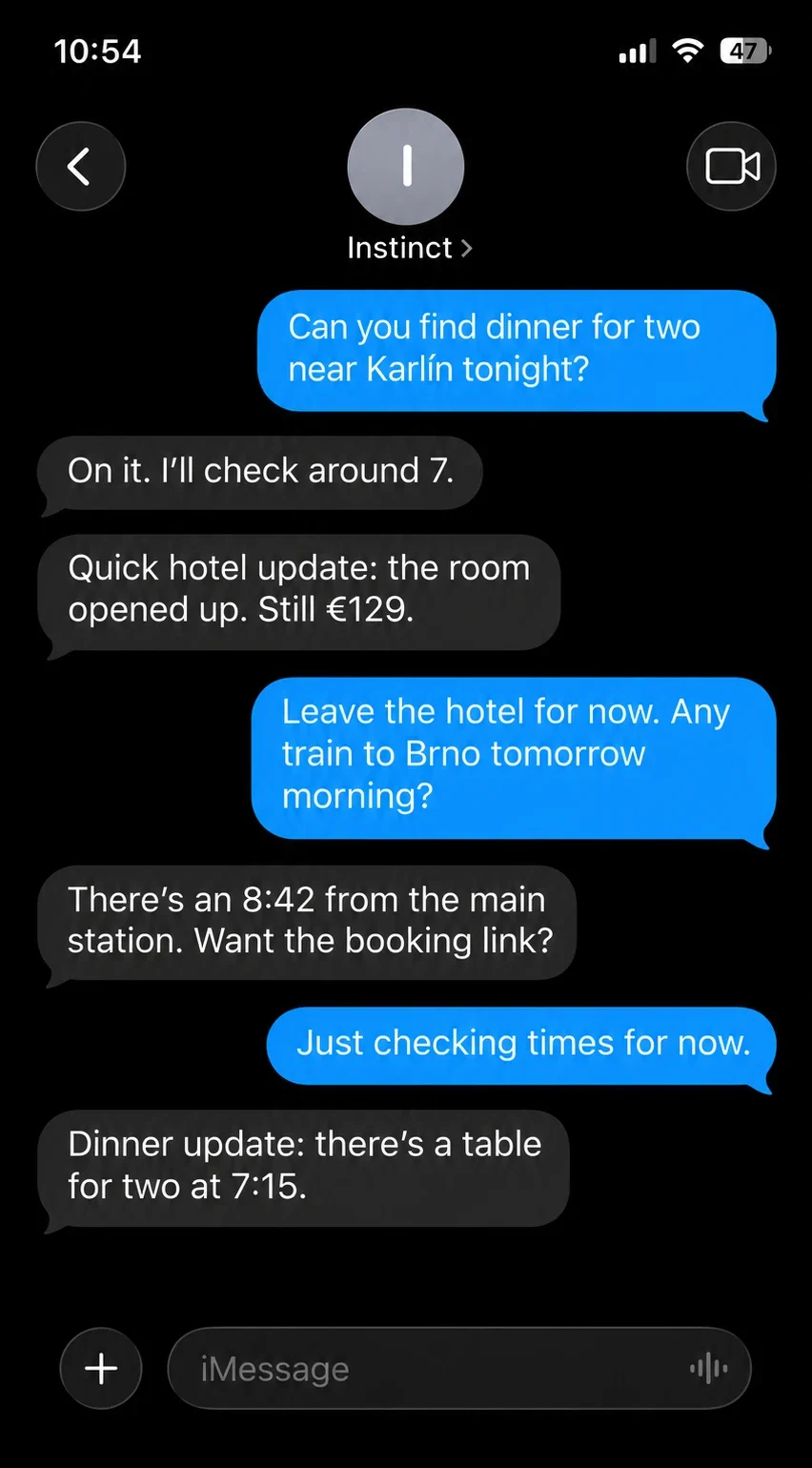
If I ask Instinct for somewhere to have dinner and it finds a place an hour later, the update comes back in the same thread.
I can see what it found without remembering to check a dashboard.
A single thread gets awkward when several jobs are running at once.
A hotel update gets buried between messages about dinner and a train.
I’d keep Messages for talking to the assistant and add a separate view where I could see what it’s working on.
How payments work
Instinct can pay for things through Stripe’s Link wallet.
When you pay through Link, you approve the purchase, then Link gives the assistant a one-time card or payment token without revealing your underlying card details.
That approval covers purchases through Link.
If the assistant can change an existing booking, the airline or restaurant can charge a fee through its own system.
How Instinct keeps working in the background
Instinct can keep working after you put your phone down.
Shinn says the assistant has its own phone and computer.
The model decides what to try, and the software around it can use a website or a connected account.
That also lets it return to a task later, even if you never send another message.
Decides what to try
Can return to the task
What background work costs
Some background jobs can run more cheaply than a live reply.
Shinn says his team can batch work that can wait minutes or hours.
The beta was free to users, but that tells us little about what it costs Instinct to keep checking a site or working through a task in the background.
Shinn has compared the product’s performance to a frontier model in internal tests.
The comparison leaves the model lineup unknown.
What Instinct finished in testing
A colleague of a reporter at The Atlantic used Instinct to look for museum tickets in Mexico City.
The tickets were sold out, so Instinct kept checking for three days.
When spots opened up, it bought the tickets and moved restaurant reservations around them.
Checking the same page every day is exactly the sort of job I’d hand off.
In the same article, the reporter asked it to help find a desk chair on Craigslist.
It found an option and drafted a message, then got stuck at a CAPTCHA, the little test a website gives you to prove you’re a person.
I like having those two stories next to each other.
Checking for tickets for three days sounds like the harder task.
On the web, one badly placed form can make sending a message harder than that.
| Errand | What happened |
|---|---|
| Museum tickets | Three days of checking Tickets bought |
| Craigslist desk chair | Message drafted Got stuck at a CAPTCHA |
What I’d let Instinct do
The Atlantic covered a case in which a user said Instinct canceled a flight while it was supposed to check the cancellation terms.
I’d let the assistant find the fee.
The decision to cancel should need its own approval.
I’d judge the assistant by what it can get done with the access I’m willing to give it.
Looking for a free tennis court can start with a neighborhood and a time.
To check against my appointments, I’d need to share my availability or connect my calendar.
I’d make the decision about giving it payment access separately.
Those are three different jobs even if I ask for all of them in a single sentence.
What happens to your data
Disconnecting Google revokes Instinct’s access to the account.
It doesn’t automatically erase data Instinct has already indexed for searches.
The privacy policy directs users to the web workspace to delete that data separately.
It also says data received through Google Workspace APIs is excluded from model training.
For other eligible data, the training opt-out applies going forward, with an exception for information flagged for safety review.
I’d want to understand those controls before handing over an inbox full of receipts and password resets.
The email prompt injection
In August 2026, early tester Alex Cohen ran an email test on his own Instinct account.
Instinct reportedly followed instructions in an incoming email and sent a summary of his open tasks to another account.
That’s a prompt injection: the assistant treated something it read as an instruction it could act on.
Cohen said he deleted his account after the test.
I’d give an assistant access to a booking confirmation so it can tell me when my flight leaves.
The email itself should never get to decide whether it changes my flight.
Why I’m waiting
I’d wait for public access and see what Instinct says about pricing and account controls then.
If I try it, I’d start with an errand that needs no inbox or card.
Find out when tickets go on sale for a concert.
Text me the date and the price.
I’ll buy them myself.
Thanks for reading,