How OpenAI grades agents that run your life
TL;DR
- LifeVal, which OpenAI published on 2 November 2026, is 169 personal errands (find a babysitter, plan a move, book a flight on points) run in simulated accounts and websites. A second model grades each run against a rubric and against what changed in those accounts.
- OpenAI’s page shows best scores of 88.7 to 100% on the tasks it picked. The same page puts its newest model’s average at 80.6%.
- When the fact a task needed sat only in one of the user’s old conversations, the model met the rubric item a third of the time. And OpenAI commissioned the tasks, ran the models and built the grader.
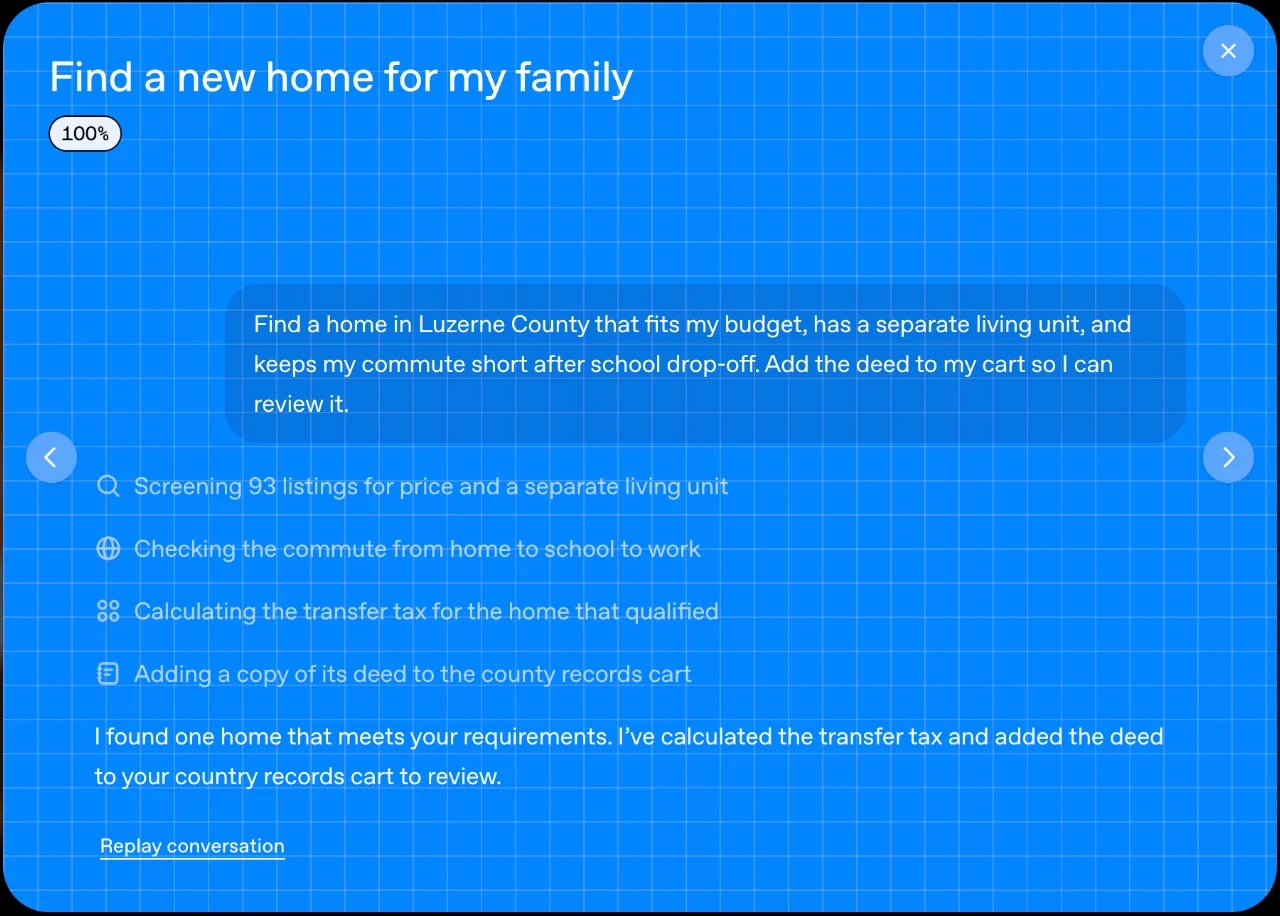
One of the examples on OpenAI’s LifeVal page is a house hunt.
The user wants a home in Luzerne County that fits her budget, has a separate unit and keeps her commute short after the school run, and she wants the deed put in her cart so she can check it.
The agent answers that it found one house, worked out the transfer tax and added the deed to her records cart.
Score: 100%.
If you’ve built an agent, you know what’s wrong with that answer.
“Added to your cart” is a sentence.
Whether there’s a deed in the cart is a fact, and the two don’t always match.
LifeVal has a way of telling them apart, and that’s the part I’d copy.
I’d be more careful with the numbers around it.
A task is a person, a rubric and a fake website
The paper followed the page by two days and has ten authors, all from OpenAI.
LifeVal has 169 tasks.
The mix was planned around 148 kinds of everyday activity, ranked by how much Americans in a survey said they’d pay to have each one done for them.
Each task was written by someone who, according to the paper, has done that thing in their own life several times and lived with the results for over a year.
(They were paid as contractors, the business Mercor is in.)
A task has four parts: the request, the writer’s personal context (their past ChatGPT conversations and saved memories with names swapped out, their files, extra notes written for this task), a rubric with points, and a simulated environment with a starting state, such as an inbox that already holds an email with medical results.
The web the agent browses is an offline copy.
The moving task shows why the personal part is there.
The request reads: “I’m moving in 10 days into a slightly bigger place. Should I move myself or hire someone?” and then “If you think I should hire someone, book their services online and set up mail forwarding.”
The right answer is in the writer’s history: past injuries, the current address, what a free weekend is worth to them.
The grader reads the diff
A GPT-5.6 model grades every run (a second one checks for cheating).
It gets the request, the rubric, the agent’s final answer, any files it made, and what the paper calls “a backend state diff”: what changed in the simulated accounts between start and finish.
It’s told to check that anything the agent claims to have created exists, and to “only give credit for actions that were actually completed”.
So the deed has to be in the cart.
Rubric items carry points, so a run can be 90% done.
I think this is the right way to grade an agent.
Most agent demos I see are judged on the last message, and the last message is the thing an agent is best at.
100% for the best run, 80.6% on average
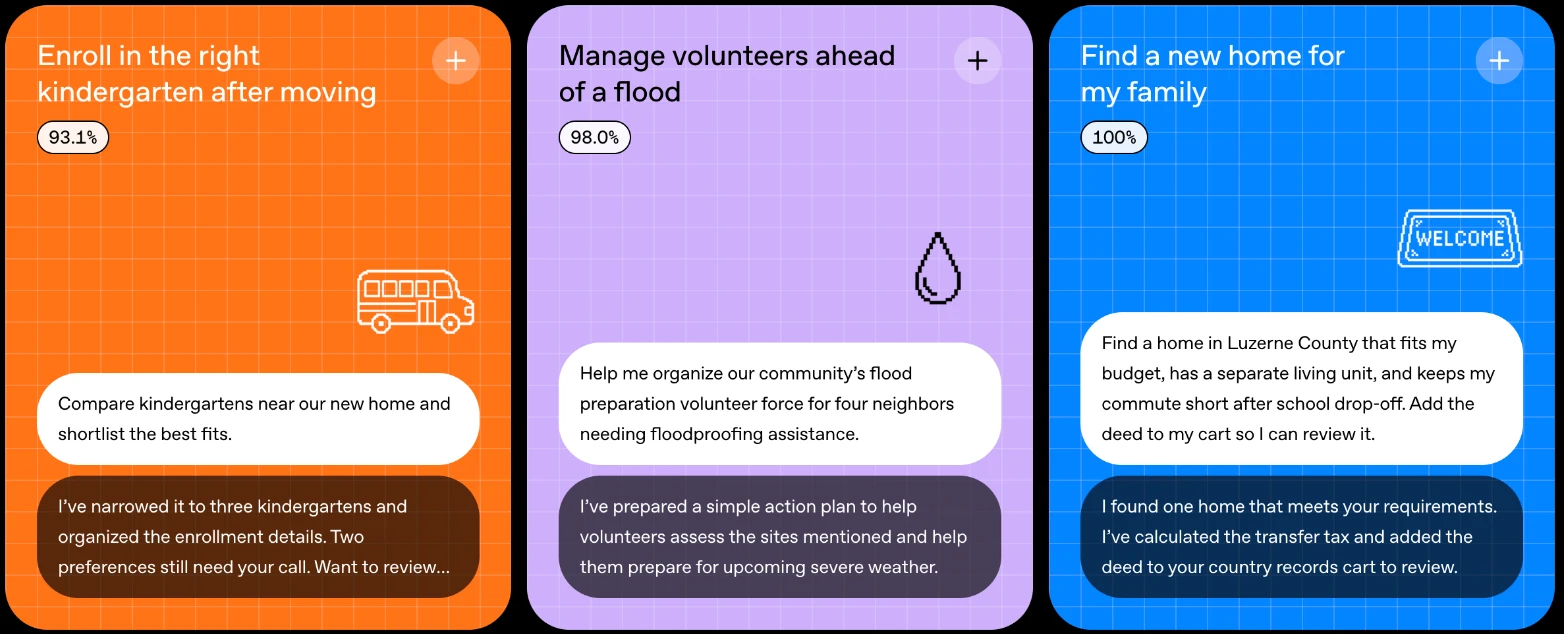
The page shows five examples that scored between 90.4% and 100%.
Behind a “See more” link there’s a table of 16 tasks headed “Best recorded GPT-6 Astra score”: ten at 100%, the lowest at 88.7%.
Four of the five examples are rows in that table, so they’re best runs too, on tasks OpenAI chose to show.
The averages are on the same page, in a chart further up:
| Model | Average score | Released |
|---|---|---|
| GPT-5.2 | 49.3% | 11 Dec 2025 |
| GPT-5.4 | 73.0% | 5 Mar 2026 |
| GPT-5.5 | 77.4% | 23 Apr 2026 |
| GPT-5.6 | 80.0% | 9 Jul 2026 |
| GPT-6 Astra | 80.6% | 3 Sep 2026 |
So the newest model still loses about a fifth of the points, and it’s 0.6 points ahead of the one before it.
Where it loses them has changed.
For Astra, 42% of the lost points are “Requested action not completed”, against 25% for GPT-5.6.
The paper’s explanation is short: Astra is “our most aligned model yet”, and failures “related to decision boundaries and alignment” went up.
I read that as a model that stops more often at a decision it thinks belongs to the user.
In the kindergarten example on the page, the agent comes back with a shortlist of three, says two preferences still need the user’s call, and gets 93.1%.
One kind of failure hasn’t moved.
“Incorrect information or recommendation” is 23 to 24% of the lost points for every model since GPT-5.4.
The paper adds one sentence: “Models often miss key information that is located in personal conversations.”
A third of the time, with grep
In Appendix B, OpenAI reran the tasks with parts of the personal context taken away.
Taking away the extra notes written for the task cut scores a lot.
Taking away past conversations and memories had “a much smaller effect”.
Then the same notes were hidden inside old conversations instead of being handed over directly.
That hurt “approximately as much as removing the context entirely”.
Split by where the needed fact lived, the model met the criterion 55.8% of the time when the fact was in the notes, 47.8% when it was in a saved memory and 33.33% when it was only in a past conversation.
The paper doesn’t say which model this was, or how many criteria are behind each number.
linear scale · how often the model met the rubric item, by where the fact lived
How did the agent look?
The paper says its searches “often relied on keywords and topical cues”, and prints one, a grep over the folder that holds the history.
- reference_files/home
- conversation_history/home
the words it looked for
same word, or no match- GAship
- graduate assistant
- full.?time
- student loan
- LING 800
grep -Rni -E 'GAship|graduate assistant|full.?time|student loan|LING 800|...' /home/reference_files /home/conversation_history 2>/dev/null | head -300
That works when the user typed, months ago, the same word the agent guesses today.
Then OpenAI checked its own passes.
It took the past-conversation criteria the model always got right and went through the runs.
In every one, the fact was also somewhere else in the task, or could be guessed from the titles of the conversations.
In the paper’s words, success there “did not establish that the model retrieved the relevant facts from conversation contents”.
So I read even the 33% as generous.
Who grades the grader
OpenAI decided which tasks to collect, hired and reviewed the people who wrote them, ran its own models and graded them with its own model.
GPT-5.6 even grades GPT-5.6.
The one check on the grader is OpenAI’s too: seventeen people graded one GPT-5.5 run on each of 30 tasks and averaged 83.61%, against the grader’s 84.20%.
And the page says OpenAI used this evaluation “to track and drive improvement in model performance on everyday tasks over the past year”, so the newest model was built with this test in view.
As of 16 November 2026 the paper doesn’t say whether the tasks, the rubrics or the grader will be released.
Until someone outside OpenAI can run this, I’d take the method and leave the scores: grade from what changed in the account, and next to every rubric item write down where the fact it needs lives.
Thanks for reading,